 Meta Verified Tech Provider · 0% markup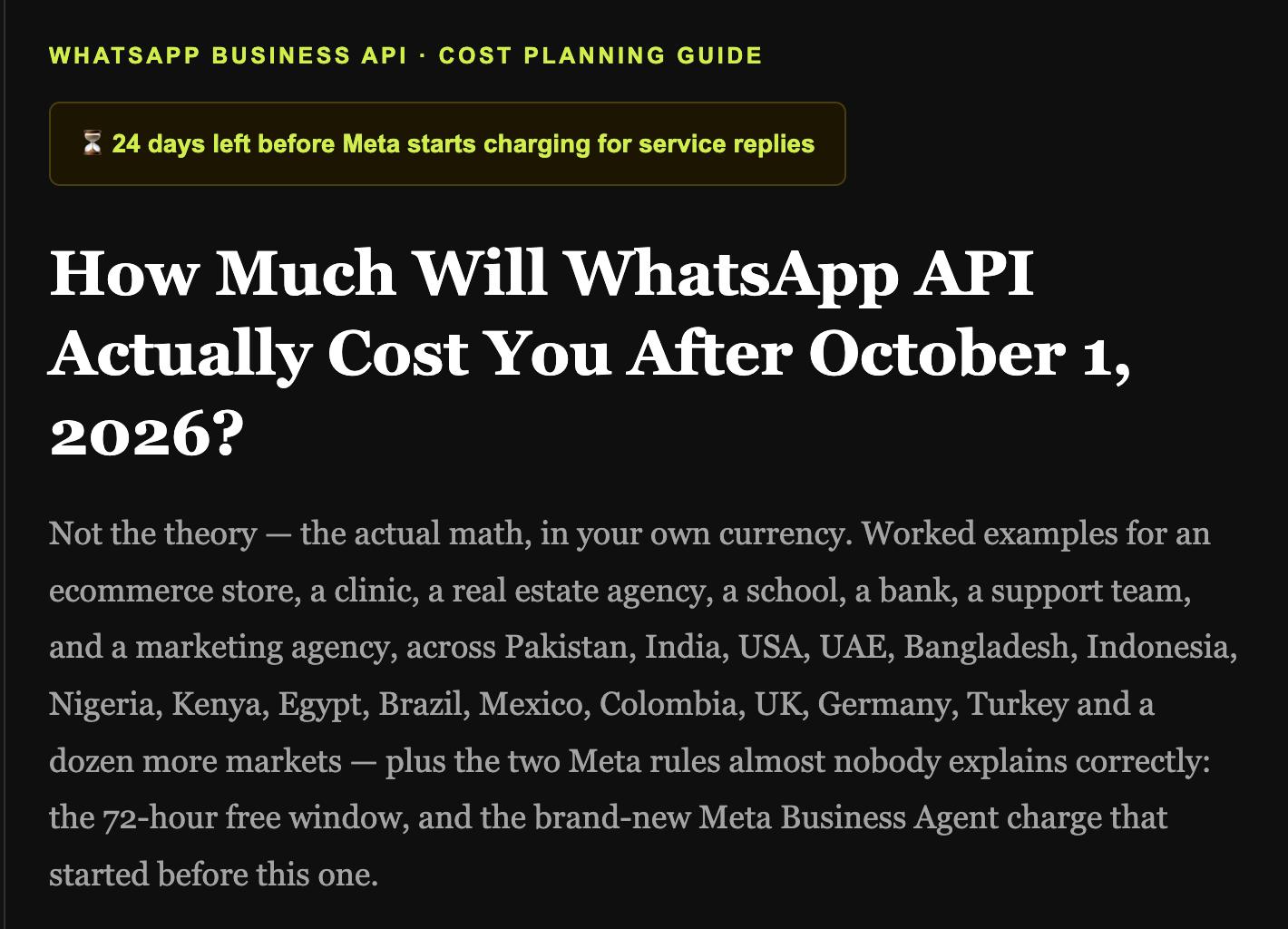
How Much Will WhatsApp API Actually Cost You After October 1, 2026?
Not the theory — the actual math, in your own currency. Worked examples for an ecommerce store, a clinic, a real estate agency, a school, a bank, a support team, and a marketing agency, across Pakistan, India, USA, UAE, Bangladesh, Indonesia, Nigeria, Kenya, Egypt, Brazil, Mexico, Colombia, UK, Germany, Turkey and a dozen more markets — plus the two Meta rules almost nobody explains correctly: the 72-hour free window, and the brand-new Meta Business Agent charge that started before this one.
Your WhatsApp bill after October 1, 2026 = (number of service replies your business sends past the free 1,000/month) × (your country's per-message rate, in your local currency) — plus, separately, whatever Meta Business Agent tokens you've used since August 1, 2026, if you use Meta's own AI rather than your own bot. Most businesses won't feel much from the service-message change alone; a support-heavy business sending thousands of replies a day, or one using Meta Business Agent at scale, will feel it more. The worked examples below use real message-volume patterns so you can plug in your own numbers instead of guessing.
Every article on the internet right now is explaining that WhatsApp is ending free service messages on October 1, 2026. Fewer are willing to sit down and actually calculate what that means for a real business in a real currency, and almost none of them mention that a second, entirely new charge — Meta Business Agent — already started a month earlier on August 1. Below are worked-out scenarios drawn from the kind of businesses we actually onboard every week — an online store, a clinic, a real estate office, a school, a bank, a support team, and an agency — spanning 25 markets, so you can find the one closest to your own operation and do the maths in five minutes, in your own currency.
If you haven't read what's changing yet in plain terms, our earlier breakdown of the 2025–2026 WhatsApp pricing timeline and the markup layer providers don't publish covers the mechanics. This guide picks up from there and focuses entirely on your actual number, wherever your customers are.
Five message types, not four — and most guides never separate the last two
Everything on WhatsApp Business API falls into one of two buckets: template messages, which are written in advance and approved by Meta before you can send them (our complete guide to Meta's template approval system covers that process end to end), and non-template messages, which are typed out freely with no pre-approval but can only ever be sent as a reply — a business can never use a non-template message to start a conversation.
Inside those two buckets sit five categories:
- Marketing (template). Anything trying to sell, promote, or prompt an action — a sale announcement, a new-product launch, a "your subscription is expiring, renew now."
- Utility (template). Transactional updates about business you've already done together — order confirmations, delivery updates, appointment reminders. Nobody is upselling you.
- Authentication (template). Strictly OTPs, login codes, and identity verification. Nothing else is allowed in this category, and this category can't be used for anything else either.
- Service message (non-template). A free-form reply written by an actual human, or by an AI bot the business built itself — your own Claude, ChatGPT, or n8n-based agent, or a platform like ours — as long as it isn't Meta's own agent.
- Meta Business Agent (non-template). A category that didn't exist a few months ago. This is Meta's own AI, replying with the AI logo you'll start seeing next to some responses. It is never free, priced entirely differently from everything else, and billed on tokens rather than per message.
Until July 2026, categories 4 and 5 above were a single "free-form message" bucket, and it was entirely free inside the right window. Meta split it in two, and only one half stayed anywhere close to free.
The two clocks that decide whether a message is free at all
Before any rate matters, two separate timers decide whether Meta even lets you send a non-template message, and whether it's free even where a charge would normally apply.
The 24-hour Customer Service Window (CSW)
The moment a customer messages you — say, 9:00 a.m. — a 24-hour window opens. Inside it, your business can send service messages and Meta Business Agent replies without pre-approval. It's a rolling window: if the same customer messages you again at 2:00 p.m., the window resets and now runs from 2:00 p.m. today to 2:00 p.m. tomorrow.
The 72-hour Free Entry Point (FEP) window
This one is different and far less well known. It triggers when someone clicks a "Send message" link on one of your Facebook or Instagram ads, or your Facebook page, and lands in a WhatsApp chat with you. That click opens a 72-hour window in which every message category — marketing, utility, authentication, and service — is free, no exceptions. The one thing that is never free, even inside this 72-hour window, is Meta Business Agent, because it's billed on tokens, not on message category.
Marketing, utility, authentication — template messages, sendable any time, always charged, and free inside the 72-hour FEP window.
Service message — non-template, sendable only inside the 24-hour CSW, free until October 1, 2026, then charged at the same rate as a utility message in that country, and free inside the 72-hour FEP window.
Meta Business Agent — non-template, sendable only inside the 24-hour CSW, charged on tokens from August 1, 2026, and never free, even inside the 72-hour FEP window.
Meta Business Agent: the charge that started a month before this one
Almost every article on the October 1 change skips over the fact that Meta's own AI agent started billing separately from August 1, 2026, at a global rate of $2 per 1,000,000 tokens. A typical reply consumes roughly 20,000–25,000 tokens, which works out to about 4–5 cents per message — but it scales with how much back-and-forth the conversation needs, and it's charged only on messages that are actually delivered.
What that looks like in practice
A business running a genuinely high volume of Meta Business Agent conversations should treat this as its own line item, separate from the service-message calculation elsewhere in this guide — it started a month earlier, it never gets a free-window exemption, and it's priced in tokens, not per-message rates, so it doesn't move with the per-country tables below at all.
Is your own AI chatbot a Meta Business Agent? No.
This is the single most common misunderstanding we hear from businesses evaluating AI-driven WhatsApp support. If you build your own bot — on n8n, on Claude, on ChatGPT, on our own On Cloud API platform, or literally any tool that isn't Meta's own agent — every reply that bot sends is a service message, not Meta Business Agent. We walk through exactly how this works, including a live setup, in managing your WhatsApp chats through Claude via our MCP integration. It doesn't matter how capable the AI is or what it costs you to run: it falls in the service category, billed at the standard utility rate for that country from October 1, 2026, plus whatever your own LLM provider separately charges you for the model itself. Businesses exploring an AI-driven support layer on WhatsApp should budget these as two distinct costs — the WhatsApp-side service-message rate, and the LLM-side token cost — rather than assuming an AI reply is automatically the more expensive Meta Business Agent category. If you're leaning toward a purpose-built bot rather than a general one, our take on task-specific WhatsApp AI agents covers why a narrow, single-job bot usually resolves a query in fewer messages than an open-ended one — which matters directly for your service-message count.
Anatomy of one real conversation: 3 charges before October 1, 5 after
Numbers in isolation are abstract. Here's what a single, ordinary cart-abandonment conversation looks like end to end, category by category, before and after the change — using India's official rates as the concrete example, since Meta has already published them.
The conversation
- Business sends a cart-abandonment reminder — a marketing template. Charged before and after October 1, no change.
- Customer replies, "do you have this in a small?" — free, customers are never charged for messaging a business.
- Business's AI agent (Meta Business Agent) answers the sizing question — non-template, free before August 1, 2026, charged per token from August 1.
- Customer replies, "do you have this in white?" — free.
- Meta Business Agent answers again — another token charge from August 1 onward.
- Customer replies, "I'm ready to check out but my card is expired" — free.
- Chat is escalated to a human support rep, who replies — non-template, service message, free before October 1, charged at the utility rate from October 1.
- Business sends an order-confirmation template — utility message, free either way because it lands inside the still-open 24-hour service window.
Nothing about this conversation changed — it's the exact same eight messages a real customer and a real support team would exchange. What changed is how many of those eight now generate a charge, and that's the shift most "free service messages are ending" headlines compress into a single line without ever running the actual sequence.
The four numbers you need before you calculate anything
Before touching a calculator, pull these from your own WhatsApp dashboard — most of this is sitting in your analytics tab already:
- Average service replies per day. Not conversations — individual messages. If your team sends 3 messages to close one query, count all 3.
- Which countries your customers are in. The rate is set by the recipient's number, not yours — a Karachi business messaging a customer in Toronto or Lagos pays that country's rate for that reply, not Pakistan's. This is destination-based pricing, not sender-based.
- How many separate messages it takes to resolve one conversation. This is the number most businesses have never measured, and it's the one that decides whether October 1 is a non-event or a real cost.
- Your current provider's markup, if you have one. This is the one variable entirely within your control — more on that further down.
Worked example 1: An ecommerce store (Pakistan & UAE)
The pattern
A mid-size online store fields "where's my order," "can I exchange this," and "is this in stock" questions all day. Say the store handles 45 customer-initiated conversations daily, each needing an average of 2.5 replies to close.
At Pakistan's utility-equivalent rate — which rose to roughly $0.0150 per message (about ₨4.20 at current exchange) as part of the same rate-card update that brings in the October 1 change — that's a genuinely small line item, a few thousand rupees a month, not a few hundred thousand. The bigger lever for a store like this isn't the per-message rate at all — it's cutting that 2.5-reply average down to 1.5 by using a structured order-status flow instead of a back-and-forth chat. Stores running catalogue and order automation through our WhatsApp API for Ecommerce setup typically resolve order-status questions in a single automated reply instead of three manual ones — which is the difference between 3,375 messages and 1,350.
Worked example 2: A real estate agency following up buyer leads (UAE, India, Pakistan)
The pattern
Real estate is different — it's outbound-heavy, not reply-heavy. An agency running 20 active listings might send 300 marketing/utility template messages a month to prospective buyers (already billed today, no change there) but only around 400 service replies answering "is this still available" or "can I see it Saturday."
This is the pattern most agencies fall into, and it's genuinely good news: if your WhatsApp usage is mostly outbound listing shares and a modest volume of buyer replies, October 1 barely touches you — your existing template costs stay exactly the same. Where agencies do get caught out is running a lead-qualification bot that asks five or six follow-up questions per lead; that volume adds up fast once you're qualifying 50+ leads a week. Our WhatsApp API for Real Estate flows are built to qualify a buyer in 2–3 structured questions instead of an open-ended chat, specifically to keep this number low.
Worked example 3: A clinic sending appointment reminders (Pakistan, UK, Canada)
The pattern
A clinic with 60 appointments a day sends a reminder template to each (already a paid utility message, unaffected by this change) and gets replies from roughly a third of patients confirming, rescheduling, or asking a follow-up question.
A single-location clinic at this volume stays free. The clinics that cross the threshold are multi-branch operations running the same reminder system across 3–4 locations under one WhatsApp number — at that point the math above multiplies directly by branch count. If that's your situation, our WhatsApp API for Healthcare setup separates reminder automation from live reply handling so you can see exactly which branch is driving your service-message count, rather than one combined number you can't act on.
Worked example 4: A school or university handling admissions (Pakistan, Bangladesh, India)
The pattern
Admissions season is the one time of year most schools' WhatsApp volume genuinely spikes. A university running an intake campaign might see 500 inbound enquiries a day for six weeks, each needing 3–4 replies to walk a parent through programs, fees, and deadlines.
This is the one scenario in this article where the number is genuinely large — and it's exactly the seasonal spike that makes a flat per-message rate with zero markup matter most, because a 15–50% markup on 51,500 messages is a very different number than 0% on the same volume. Institutions running enquiry automation through our WhatsApp API for Schools setup usually cut the reply count per enquiry from 3.5 to under 2 by using a structured programme-selection flow, which alone would take the example above from 51,500 billable messages down to roughly 29,000.
Worked example 5: A bank or fintech sending OTPs and handling queries (USA, UK, UAE, India)
The pattern
Authentication messages (OTPs) were never free and aren't affected by this change. What changes for a bank is the customer support layer sitting on top — balance queries, card-block requests, and dispute follow-ups sent as service replies.
For a bank or fintech, this is a rounding error next to the cost of a call-centre seat — but the compliance angle matters more than the cost here. Financial services businesses should treat this as the moment to formally audit their WhatsApp API for Banking template categorisation, since Meta is also tightening the utility-vs-marketing line in this same update cycle, and a wrongly categorised template costs far more than the service-message change itself. Worth flagging too: authentication messages carry an international premium in several of these markets — India, UAE, Egypt and Saudi Arabia among them — so a bank verifying customers across borders should check that rate separately from its domestic OTP cost.
Worked example 6: A US or Canadian support team (North America)
The pattern
North American service and utility rates are among the lowest in the world in absolute dollar terms — but US and Canadian support teams also tend to run the highest raw message volumes, so the total can still add up. Say a mid-size US ecommerce brand runs a support desk handling 300 conversations a day at 2 replies each.
Under $60 a month for 18,000 messages is a non-event for most US businesses — the US rate is one of the cheapest per-message anywhere, sitting alongside Canada in what Meta groups as the North America tier. Where it does matter is at genuinely large scale: a US brand running 500,000 service messages a month would see roughly $1,700 in new charges it wasn't paying before October 1, which is exactly the kind of volume where a 0%-markup provider saves real money compared to a BSP charging even a small per-message margin on top.
Worked example 7: A support team across Indonesia, Nigeria, Kenya, Egypt and Ghana
The pattern
These five markets sit at very different price points from each other despite all falling under Meta's "developing market" style tiers, and they're also the markets we see the most search interest from without matching traffic — usually because the content businesses find doesn't speak to their currency at all. Take a Nairobi-based delivery service handling 900 service replies a month across Kenya and neighbouring markets.
Compare that to a Lagos fintech running the same 3,000 billable messages at Nigeria's roughly $0.0067 rate (~$20/month), a Cairo retailer at Egypt's roughly $0.0036 rate (~$11), a Jakarta store at Indonesia's roughly $0.0036 rate (~$11), or an Accra business at Ghana's roughly $0.0040 rate (~$12). None of these are large numbers in isolation — the point is that a business in any of these markets can now get an honest answer in minutes instead of extrapolating from a US-dollar example that assumes a completely different rate tier.
Worked example 8: A retail chain across Brazil, Mexico, Colombia and Argentina
The pattern
Latin America has the widest internal spread of any region in this article — Colombia sits at roughly $0.0008 per message, among the cheapest rates Meta publishes anywhere, while Argentina runs closer to $0.0260. A regional retail chain running the same support desk in all four countries, at 5,000 billable service messages a month per market, sees four very different bills from identical usage.
For a finance team budgeting across all four markets, this is the single most important thing to get right about LatAm: don't apply one regional average. Colombia and Argentina alone differ by more than 30x on the exact same message volume. Brazil is also worth watching separately, since Meta has been rolling out native BRL billing through 2026 rather than billing Brazilian accounts in US dollars, which changes how the number shows up on your invoice even when the underlying rate hasn't moved.
Worked example 9: An agency running campaigns across UK, Germany, France, Portugal and Turkey
The pattern
Western Europe has some of the highest per-message rates in the world — Germany's utility/service rate runs around $0.0550, roughly 60x Colombia's — while Turkey, geographically close but priced very differently, sits near $0.0009, among the lowest rates anywhere. A marketing agency managing WhatsApp support for clients in all five markets needs to budget each one separately, not as "Europe."
The gap between Germany and Turkey on identical volume is the clearest illustration in this whole article of why "WhatsApp API costs $X" is close to meaningless without a country attached. For agencies billing clients on a cost-plus basis, this is also exactly where a markup percentage compounds fastest — a 20% markup on Germany's rate costs a client far more per message than the same 20% would on Turkey's.
India in exact rupees, per Meta's own October 1, 2026 rate card
India is the one market where we can quote Meta's published rate card directly rather than working from a secondary source, so it's worth showing in full as a template for how to read your own country's card.
| Category | Rate (effective October 1, 2026) | Changed from July 1, 2026 card? |
|---|---|---|
| Marketing | ₹0.8631 | No — already charged, no change |
| Utility | ₹0.1150 | No — already charged, no change |
| Authentication | ₹0.1150 | No — already charged, no change |
| Service message | ₹0.1150 | Yes — was ₹0.0000 (free) on the July 1, 2026 card |
Note that Meta's card sets the service-message rate equal to the utility rate in every market — this is the pattern to expect in your own country's card too, not a coincidence specific to India.
Country-by-country: where your recipients are decides your rate
One thing trips up almost every business doing this calculation for the first time: the rate is set by the recipient's country code, not where your company or server sits — this is destination-based, not sender-based, pricing, and it holds even for authentication and marketing messages. A Lahore-based support team replying to a customer in Toronto pays Canada's rate for that message, not Pakistan's. Below is every market where we see meaningful search interest for this guide, with the currency you'll actually be billed or budgeting in.
| Market | Local currency | What to check |
|---|---|---|
| 🇵🇰 Pakistan | PKR (Meta bills in USD) | Utility/service rate rose to roughly $0.0150 as part of the same cycle that brings in the October 1 change — check your current template category before adding this on top. |
| 🇧🇩 Bangladesh | BDT (Meta bills in USD) | Now tracked as its own market rather than folded into a regional tier, with a utility/service rate closer to $0.0037 — OTP-heavy apps should budget authentication separately. |
| 🇮🇳 India | INR ₹ (billed natively since Jan 2026) | Utility, authentication and service all sit at ₹0.1150 per Meta's official October 1, 2026 card; marketing is ₹0.8631. Authentication-international carries a steep premium, so cross-border OTP traffic costs far more than domestic. |
| 🇦🇪 UAE & Dubai | AED د.إ (billed natively) | Utility/service around $0.0157. Named among markets with marketing-rate increases in this cycle — Gulf-facing businesses should re-check marketing template spend too, not just service messages. |
| 🇮🇩 Indonesia | IDR Rp (billed natively) | Utility/service estimated around $0.0036, though published figures vary by source — confirm against Meta's current card before quoting a client. |
| 🇰🇪 Kenya | KES (Meta bills in USD) | Falls under Meta's Rest of Africa tier, roughly $0.0040 per utility/service message. |
| 🇺🇸 USA | USD $ (billed natively) | Around $0.0034 — one of the lowest per-message rates anywhere, but high daily volumes mean the service-message change is still the bigger line item for most US businesses. |
| 🇧🇷 Brazil | BRL R$ (native billing rolling out through 2026) | Utility/service around $0.0068. Watch for the currency your invoice actually shows — Meta has been transitioning Brazilian accounts from USD to BRL billing during 2026. |
| 🇬🇧 UK | GBP £ (billed natively) | Published utility/service figures range roughly $0.0171–$0.0220 depending on source — no major standalone rate-card swing reported this cycle, so the service-message change applies at the standard rate. |
| 🇲🇾 Malaysia | MYR RM (billed natively) | Utility/service around $0.0140. |
| 🇪🇬 Egypt | EGP (Meta bills in USD) | Utility/service around $0.0036. |
| 🇩🇪 Germany | EUR € (billed natively) | Utility/service around $0.0550 — one of the highest rates in this list, roughly 60x Colombia's on the same message. |
| 🇸🇦 Saudi Arabia | SAR ﷼ (billed natively) | Utility/service around $0.0107. Marketing rates rose in the same cycle as Pakistan's utility increase. |
| 🇹🇷 Turkey | TRY ₺ (Meta bills in USD) | Utility/service around $0.0009 — among the cheapest rates published, and it was lowered further in an earlier 2026 rate-card update. |
| 🇳🇬 Nigeria | NGN ₦ (Meta bills in USD) | Utility/service around $0.0067; authentication-international carries a notably higher premium than domestic in this market. |
| 🇨🇴 Colombia | COP $ (billed natively) | Utility/service around $0.0008 — the lowest published rate of any market in this table. |
| 🇨🇦 Canada | CAD C$ (Meta bills in USD) | Grouped with the US for North American rate adjustments, roughly $0.0034. |
| 🇸🇬 Singapore | SGD S$ (billed natively) | Utility/service around $0.0113. |
| 🇫🇷 France | EUR € (billed natively) | Utility/service around $0.0300. |
| 🇦🇺 Australia | AUD A$ (billed natively) | Utility/service around $0.0113. |
| 🇲🇽 Mexico | MXN Mex$ (billed natively) | Utility/service around $0.0085; marketing rates rose separately in the same October cycle. |
| 🇦🇷 Argentina | ARS $ (billed natively) | Utility/service around $0.0260 — one of the higher rates outside Western Europe. |
| 🇵🇹 Portugal | EUR € (billed natively) | Utility/service around $0.0171. |
| 🇨🇳 China | CNY ¥ (Meta bills in USD) | Utility/service around $0.0113. |
| 🇬🇭 Ghana | GHS ₵ (Meta bills in USD) | Falls under the same Rest of Africa tier as Kenya, roughly $0.0040. |
Meta finalises exact per-country rate cards close to the effective date, and some published figures (Indonesia and UK in particular) vary between secondary sources — always confirm current numbers on Meta's official pricing page before locking a budget. Use the figures above to know which direction to plan in and which currency your invoice will actually show, not as exact billing figures to quote a client without checking.
Five things about this pricing change nobody explains
- It's destination-based pricing, not sender-based. A business in India messaging someone in the US is billed at the US rate for that message, not India's — the recipient's country decides the price every time.
- You only pay for messages that actually deliver. If a number is invalid or the message fails for any reason, Meta doesn't charge for it. The charge triggers on that single grey tick, not on the send attempt.
- There's a per-user marketing message limit tied to engagement. Meta caps how many marketing messages a single user can receive based on how much they actually engage with your business — reply, open, interact. Ignore a business consistently and that user's limit drops; engage a lot and it rises. You can't simply message someone daily regardless of response.
- There's also an account-level messaging tier. Every WhatsApp Business account has a limit on how many unique people it can reach per day, independent of the per-user marketing cap above.
- Mislabeling a template gets it auto-reclassified, not just penalised. Tag something as utility to get the cheaper rate when it's actually promotional, and Meta's systems detect it and automatically reclassify the template to marketing — regardless of how the wording is phrased. This happens even on genuine mistakes, not just deliberate attempts to save money, so it's worth auditing template categorisation before October 1 rather than after an email from Meta forces the issue — our template approval system guide walks through how Meta's review actually works.
What actually cuts your bill (in order of impact)
- Reduce replies-per-resolution, not reply speed. A faster reply doesn't save money if it still takes four messages to close a query. A structured flow that closes it in one does.
- Move genuinely low-volume, high-touch chats to Coexistence. A human replying from the WhatsApp Business app itself — for VIP clients or sensitive cases — has never been charged, before or after October 1, and never will be, because charges only apply to messages sent through the API.
- Audit template categorisation before October 1. A template wrongly filed as marketing instead of utility costs more per message than the entire service-message change will, for most businesses — and Meta will auto-reclassify it anyway once its systems catch the mismatch.
- Know your actual currency, not just the dollar figure. A US-dollar rate card doesn't tell a Jakarta or Lagos business anything useful for budgeting — convert to your local currency and your actual invoice currency before presenting a number internally.
- Separate your Meta Business Agent spend from your service-message spend. They're billed on completely different models — tokens versus per-message — and confusing the two makes it impossible to see which one is actually driving your bill.
- Remove markup from the one part of the bill you can control. Meta's rate isn't negotiable for anyone, and it varies by up to 60x between markets like Colombia and Germany. What your provider adds on top of it is negotiable — and compounds hardest in exactly the high-rate markets where it hurts most.
Run your own numbers — free, live Meta rates, 0% markup, any currency
Instead of estimating, plug your monthly message volume and country into our live WhatsApp Cost Calculator — it shows Meta's exact current per-message rate for your market, with nothing added on top. Compare that against what a 15–50% markup provider like AiSensy, Twilio, DoubleTick, or Gallabox would charge on the same volume, and the gap after October 1 tells its own story — especially in the higher-rate markets like Germany, UAE and Argentina where a percentage markup does the most damage.
Frequently asked questions
Is WhatsApp Business API still free to use in 2026?
Sending the API itself has no licence fee — you only ever pay Meta per message once you're past the free tiers. What changed on October 1, 2026 is that one of those tiers, the 1,000 free service replies per number, now has a per-message cost attached the moment you exceed it, exactly like marketing and utility templates already did.
What is Meta Business Agent, and is my own chatbot the same thing?
No. Meta Business Agent is Meta's own AI, billed separately on tokens ($2 per million, roughly 4–5 cents a typical reply) from August 1, 2026, and it's never free — not even inside the 72-hour free entry point window. A bot you build yourself, on any other platform, is a service message, billed at the standard utility rate from October 1, 2026, plus your own AI provider's cost.
Does replying from my own phone cost anything?
No. Replying through the WhatsApp Business app on your own phone, including via WhatsApp Coexistence, has never been charged and stays completely free both before and after October 1, 2026. Only messages sent through the WhatsApp Business API are billable.
How much will WhatsApp API cost my ecommerce store after October 2026?
Once you're past the 1,000 free service messages Meta gives every business number monthly, every order-status or support reply inside the 24-hour window bills at your country's rate. A store sending around 1,200 support messages a month would pay for roughly 200 of them — see the full worked example above for the exact method, and the country table for your local rate.
How much does WhatsApp Business API cost in the USA versus India?
A US service or utility message runs about $0.0034, while the same message sent to an Indian number costs ₹0.1150 per Meta's official October 1, 2026 card (roughly 1.3 US cents). The rate always follows the recipient's country code, not the sender's — a US business replying to Indian customers pays India's rate for that message, and vice versa.
Do WhatsApp appointment reminders cost more after October 1, 2026?
The reminder template itself was already a paid utility message. What's new is that a follow-up reply your clinic sends inside the same open conversation — previously free — now bills at the same rate.
How many free WhatsApp service messages does a business get per month?
1,000 per WhatsApp Business Platform phone number, per calendar month, direct from Meta, with no rollover. Anything beyond that inside the 24-hour customer service window is billed per message starting October 1, 2026.
What is the 72-hour free entry point window, and does it cover everything?
It's a 72-hour window that opens when someone clicks into WhatsApp from one of your Facebook or Instagram ads or your Facebook page. Inside it, marketing, utility, authentication, and service messages are all free — but Meta Business Agent replies are never free, in this window or any other, because they're billed on tokens rather than message category.
What happens if I don't add a payment method before October 1, 2026?
Meta doesn't send an invoice and wait for payment. If there's no valid card or credit line on file in your WhatsApp Business billing hub, Meta simply stops delivering your service messages the moment the free allowance runs out — your replies stop going through until a payment method is added.
Which country has the cheapest WhatsApp Business API rate, and which has the most expensive?
Among the markets we cover here, Colombia sits at the low end, around $0.0008 per utility/service message, while Germany sits at the high end, around $0.0550 — roughly a 60x spread on an identical message. This is exactly why one global dollar figure doesn't tell you much; check the country table above for your actual market.
Is WhatsApp still cheaper than phone support after this change?
Yes, for almost every business. Even at the new rate, a WhatsApp reply costs a fraction of a cent to a few cents in most markets, and even in the highest-rate markets it remains far below the cost of an additional phone-support hire. The change affects budgeting precision, not whether WhatsApp remains the lower-cost channel.