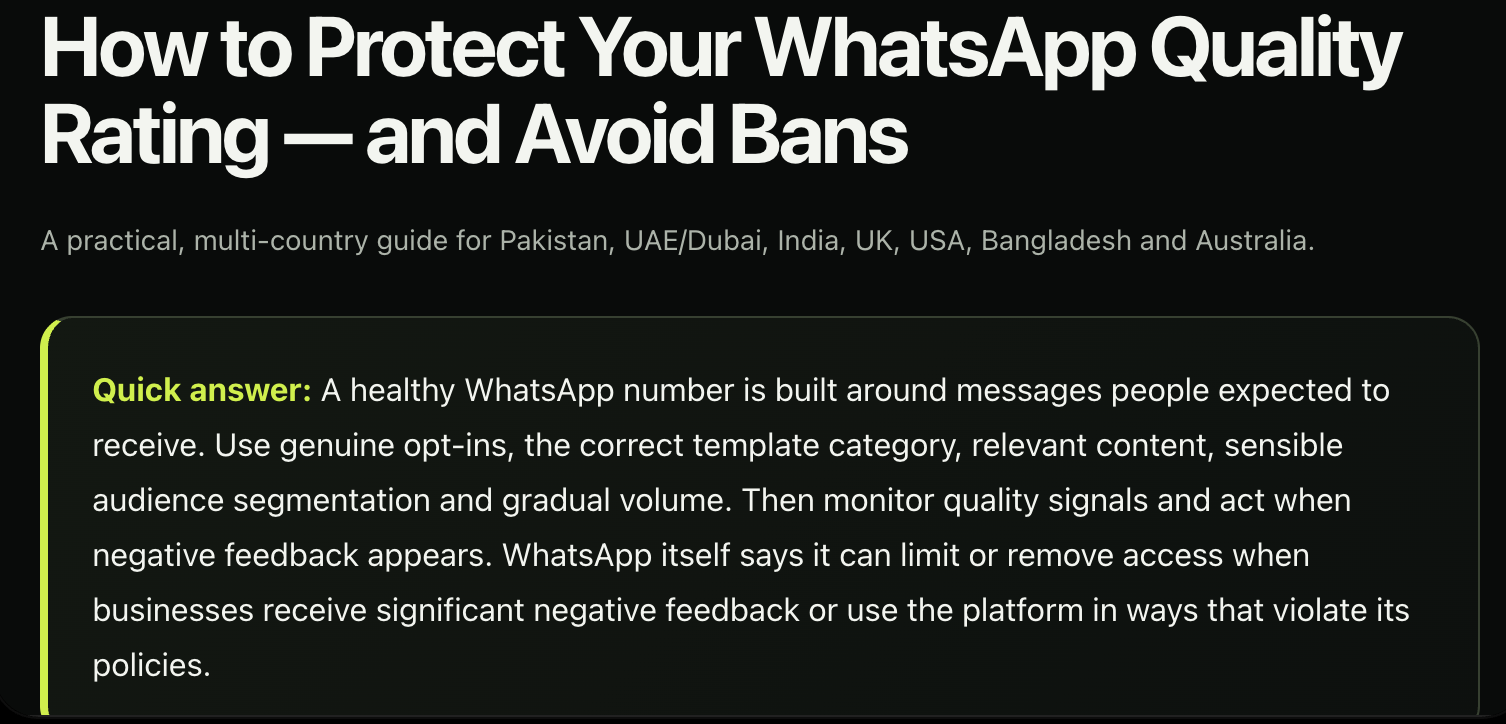
How to Protect Your WhatsApp Quality Rating — and Avoid Bans
What WhatsApp quality rating actually tells you
Quality rating is not a marketing badge you can buy. It is a health signal around how recipients respond to business messaging. WhatsApp's own materials show quality rating alongside phone-number status and messaging limits in WhatsApp Manager, and its Business Policy says sustained low quality can lead to limits on messages or calls a business can initiate.
That makes quality a useful operating metric. Instead of waiting for a restriction, treat blocks, reports, poor engagement and template-level feedback as signals that the audience, offer, timing or message itself needs attention.
WhatsApp also states that businesses must maintain accurate profile information, avoid impersonation and provide a quality customer experience.
The signals your team should watch
| Signal | What it means operationally | What to do |
|---|---|---|
| Blocks | The recipient no longer wants messages from the business. | Remove the contact from the relevant messaging audience and investigate why the campaign created that reaction. |
| Reports | A stronger negative-feedback signal than simply ignoring a message. | Stop scaling the affected campaign and review consent, targeting and content. |
| Template quality | WhatsApp provides performance and quality information for templates. | Retire or rewrite templates that repeatedly create negative feedback. |
| Delivery/read behaviour | Helps reveal whether your audience still expects the content. | Segment inactive users rather than repeatedly sending the same campaign. |
| Phone-number quality | Shows the broader health of your sending number. | Watch for a move away from High quality and investigate early. |
WhatsApp's marketing best-practices material specifically shows businesses can inspect delivered messages, read rate and top block reason in the template-performance view. citeturn1view2
A practical 5-step process for keeping your number healthy
Start with a real opt-in
Do not treat a phone number as permission. Build the audience from places where the customer actually agreed to hear from the business: a website form, checkout flow, QR journey, Click-to-WhatsApp experience or another documented consent path. The exact wording should make the intended WhatsApp communication clear.
Match the message to its purpose
A delivery update, authentication message and promotional offer are not interchangeable. Use the appropriate approved template category and do not disguise marketing content as utility simply to make it look transactional.
Segment before you send
One campaign rarely belongs to every contact in your CRM. Separate recent buyers, active leads, support customers and dormant contacts. Relevance is a quality-control mechanism: the less irrelevant the message feels, the less reason the recipient has to block or report it.
Scale gradually
A new or recently changed sending setup should not be treated like a mature audience with unlimited historical engagement. Increase volume in a controlled way and watch the quality signal as you scale. WhatsApp's onboarding guidance explicitly warns that scaling can erode personalization, create excessive messaging and cross opt-in boundaries.
React before the problem becomes a restriction
If quality deteriorates, do not simply send more messages to compensate. Pause the problematic campaign, identify the source of negative feedback, remove unsuitable contacts, review the template and then resume only after the cause has been addressed.
Good practice vs. the shortcuts that hurt
Good
- Document genuine opt-in.
- Use the correct approved category.
- Send useful, expected content.
- Segment inactive and active audiences.
- Monitor quality and block reasons.
- Make opt-out handling part of the workflow.
- Use official WhatsApp Business Platform infrastructure.
Avoid
- Buying or scraping contact lists.
- Cold blasting unfamiliar numbers.
- Sudden unexplained volume spikes.
- Calling a promotion a utility message.
- Ignoring repeated blocks or reports.
- Using modified WhatsApp apps or unofficial bulk-sender tools.
- Believing a provider can guarantee immunity from bans.
WhatsApp's own responsible-use guidance warns against unwanted messages, automated or bulk messaging that violates its rules, and modified versions of WhatsApp. Its Business Policy also says unauthorized messaging at scale can result in access being limited or removed. citeturn0search2turn2search1
Country-by-country quality strategy
The enforcement principles are platform-wide, but the way a campaign is received is local. Language, audience expectations, sector and local privacy obligations should shape the implementation rather than creating seven completely different compliance systems.
Pakistan: make consent and local relevance visible
For Pakistani businesses, the practical opportunity is to build a clean audience from real customer journeys instead of relying on old contact exports. Local ecommerce, fintech, education, healthcare and service businesses can all use the same quality framework: document consent, keep templates purpose-specific and watch recipient feedback. For Pakistan-focused API setup and compliance context, see On Cloud API's Pakistan WhatsApp Business account guide.
Use PKR examples in internal campaign reporting if that is how your finance team works, but do not confuse local currency reporting with WhatsApp's own quality signal.
UAE / Dubai: relevance matters in a high-intent sales environment
Dubai campaigns often span lead generation, property enquiries, retail and service conversations. Keep the first message tightly connected to the action that created the lead. For real-estate teams, a person who requested a property viewing should not automatically be treated as permission for every future promotional campaign. Consent should match the communication you intend to send.
For UAE operations, review applicable local privacy requirements alongside WhatsApp's own Business and Commerce policies. Do not assume that using a UAE phone number or AED billing makes a campaign compliant by itself.
India: separate high-volume acquisition from engaged audiences
India's large and diverse customer base makes segmentation especially important. Separate users by language, product interest and recency where your CRM supports it. Do not let a large database become an excuse to send the same template to everyone. WhatsApp's own marketing guidance also surfaces India-specific template information in its manager materials, so template monitoring should be part of the routine.
UK: keep consent and preference management explicit
For UK campaigns, build WhatsApp consent and preference handling into the customer lifecycle instead of treating it as a spreadsheet column. Promotional campaigns should be relevant to the audience that agreed to receive them, and businesses should review the privacy and marketing rules applicable to their own sector before scaling.
USA: be especially careful with campaign assumptions
Do not assume that an approved template means every recipient wants it. Segment by actual customer relationship and campaign intent, monitor feedback and verify the current WhatsApp rules for the destination market before launching a large campaign. The platform's quality framework remains feedback-driven.
Bangladesh: local language and audience context can improve relevance
For Bangladesh, a practical quality strategy is to make the customer's reason for receiving the message obvious. Where Bengali-language communication is appropriate for the audience, make the message natural rather than mechanically translated. Keep the same core controls: consent, correct category, segmentation and quality monitoring.
Australia: treat messaging preference as part of customer experience
Australian businesses should build WhatsApp messaging into a broader preference-management approach. The same platform rule applies: the safest campaign is one that a recipient expected, can understand and can opt out of. Review sector-specific privacy and marketing obligations separately from WhatsApp's platform policies.
Why approved templates still need monitoring
Approval is not the end of the quality process. WhatsApp's materials expose template performance information such as delivered messages, read rate and top block reason, while third-party documentation describing Meta's system notes that template quality can change as recipients interact with messages. A template that looked fine during submission can still perform badly with a real audience.
That is why a good WhatsApp marketing team has two checkpoints: before sending (permission, category, audience and content) and after sending (delivery, reads, blocks, reports and quality).
What to do when quality drops
- Stop scaling. Do not respond to weak performance by increasing volume.
- Identify the affected audience. Look for the campaign, segment, template or acquisition source associated with the negative feedback.
- Review consent. Confirm that the recipient actually agreed to the kind of message being sent.
- Review the template. Check category, promise, links, offer and wording.
- Clean the audience. Remove people who opted out or clearly do not want the communication.
- Resume carefully. Start with a smaller, highly relevant audience and continue monitoring.
If the account is actually banned, WhatsApp's Help Center says the review process is handled by WhatsApp and that third-party services cannot remove a ban. citeturn0search1turn0search6
Where On Cloud API fits
The role of an API provider is not to make policy disappear. The useful role is to give a business the infrastructure and operational controls needed to run an official WhatsApp Business Platform setup with templates, automation, team workflows and monitoring.
On Cloud API positions itself as a Meta Verified Tech Provider and its current site exposes WhatsApp team inbox, templates, broadcasts, automation and quality/compliance-oriented features. The important distinction is that those tools should be used to improve message quality, not to manufacture volume.
If you are building a serious sending workflow, start with the platform architecture and approved-message rules, then connect your CRM or automation layer. The broader implementation details are covered in On Cloud API's WhatsApp Business API customer-support guide.
Frequently asked questions
What is a WhatsApp quality rating?
It is a quality signal associated with a WhatsApp Business phone number that reflects recipient response to business messaging. WhatsApp exposes quality information in WhatsApp Manager.
What causes a WhatsApp quality rating to fall?
Negative recipient feedback such as blocks and reports can hurt quality. Unwanted messaging, poor targeting, incorrect template use and policy violations can also create enforcement risk.
Does using the WhatsApp Business API prevent bans?
No. The official API does not guarantee immunity. Businesses still need to follow WhatsApp Business and Commerce policies and maintain a good customer experience.
Should I buy a WhatsApp contact list?
No. Purchased or scraped lists create a high risk of unwanted messages, blocks and reports. Build audiences from genuine opt-in sources instead.
What should I do if quality turns low?
Pause the problematic activity, review consent and targeting, inspect template performance, clean the audience and correct the root cause before scaling again.
Can a provider guarantee that my number will never be banned?
No. WhatsApp controls enforcement. A compliant setup and disciplined messaging practices reduce avoidable risk but cannot guarantee immunity.
Where can I check quality signals?
WhatsApp's materials show quality rating, phone-number status, messaging limits and template performance information inside WhatsApp Manager.
Final checklist before your next campaign
| Check | Pass condition |
|---|---|
| Permission | Every recipient has a genuine, relevant opt-in for the communication. |
| Category | The template category matches the actual purpose of the message. |
| Audience | The segment is relevant and not simply the largest list available. |
| Content | The offer or update is clear, useful and not misleading. |
| Volume | Sending is controlled rather than an unexplained spike. |
| Monitoring | Someone is watching delivery, reads, blocks, reports and quality. |
| Recovery | There is a defined action plan if quality deteriorates. |