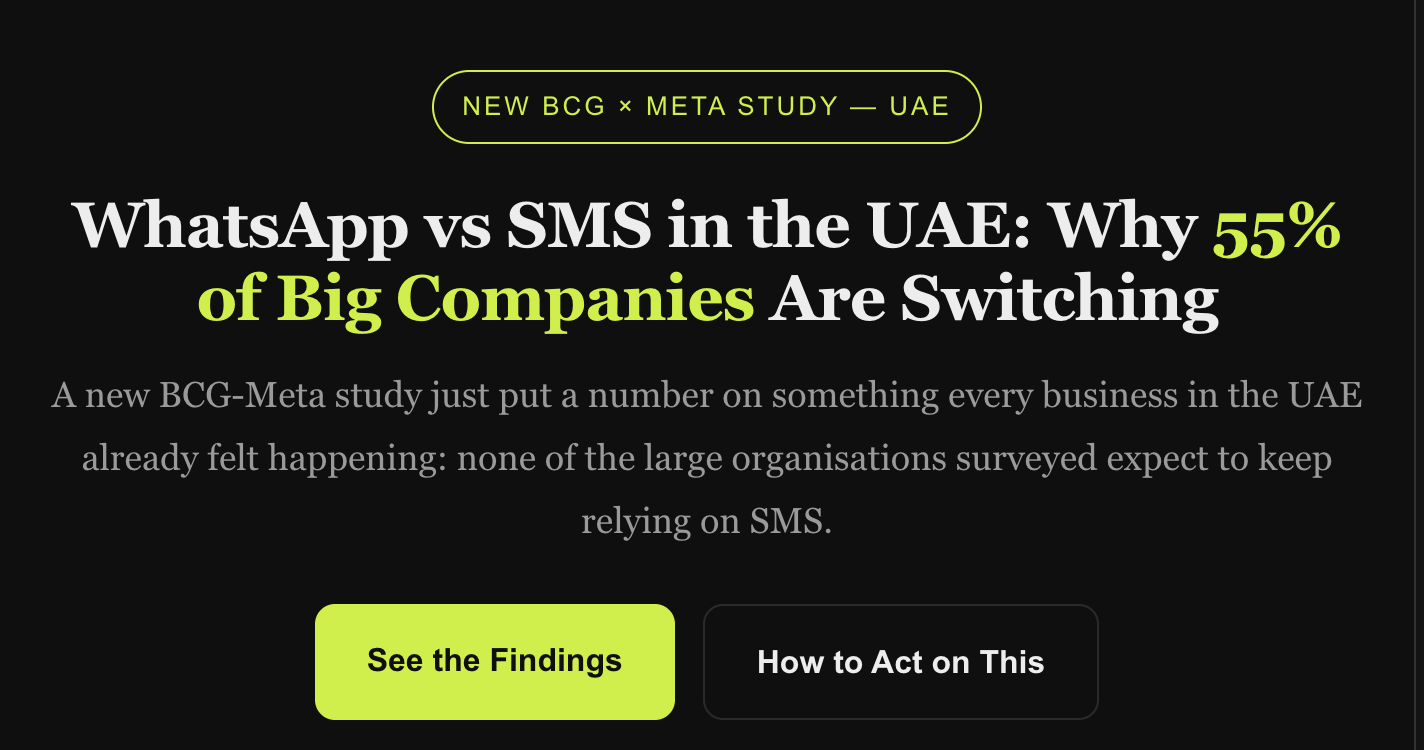
WhatsApp vs SMS in the UAE: Why 55% of Big Companies Are Switching
A new BCG-Meta study just put a number on something every business in the UAE already felt happening: none of the large organisations surveyed expect to keep relying on SMS.
Last updated: September 17, 2026 · Report findings cross-checked across Arabian Business, MIT Sloan Management Review Middle East, TahawulTech and Business Today Middle East
Quick answer: A Boston Consulting Group and Meta study of large UAE organisations found that 55% plan to make rich messaging platforms — chiefly WhatsApp — their top customer-engagement investment over the next five years, and zero percent of the companies surveyed expect to keep relying on SMS. If your business is still running order updates and OTPs through SMS, this report is the number that makes the switch a business case, not a nice-to-have.
What the BCG-Meta report actually found
Boston Consulting Group and Meta surveyed large UAE organisations on where they're putting their customer-engagement budget for the next five years. The headline number isn't subtle.
BCG Middle East managing director and partner Andy Veitch framed it as the UAE already being an advanced adopter of business messaging, with clear room left to fully capture the value of AI-powered messaging. Meta's regional director for MEA, Fares Akkad, put similar numbers behind the shift: companies using rich messaging across multiple customer touchpoints reported roughly 2x higher customer lifetime value and about 1.5x lower customer acquisition cost, alongside 2x higher open rates than email, 3x better return on ad spend than SMS, and up to 12% higher OTP authentication success rates.
The report's own conclusion is the part worth sitting with: the UAE businesses that actually win this shift won't be the ones that just move their SMS traffic to WhatsApp unchanged. They'll be the ones that build AI-ready data systems and a unified operating model around messaging — treating it as a continuous conversation interface, not a broadcast tool.
The case study everyone's citing: LuLu Hypermarket
The report leans on one retail example that makes the abstract numbers concrete.
After LuLu Hypermarket shifted key customer touchpoints — receipts, offers, loyalty communication — to WhatsApp, the retailer reported significantly higher engagement, millions of dollars saved in reduced printing costs, and millions of new loyalty programme sign-ups directly attributed to the channel. That's not a small pilot; it's a national grocery chain moving core operational communication off paper and SMS onto a conversational channel.
Why this matters beyond retail: the mechanics that worked for LuLu — receipts, loyalty, and offers moved into one thread the customer already checks daily — apply just as directly to real estate, healthcare, ecommerce and any business currently paying for SMS delivery confirmations and paper printing.
Why WhatsApp beats SMS operationally
❌ SMS
- Plain text only, 160 characters.
- One-way — no real conversation thread.
- No native automation or CRM context.
- Per-message cost with no free service window.
✅ WhatsApp Business API
- Rich media — images, catalogues, buttons, documents.
- Two-way conversation the customer can reply to directly.
- Connects to CRM, chatbot flows and automation.
- Free 24-hour service window once the customer messages first.
This is exactly the gap the report is describing: SMS was never built for a two-way, media-rich, AI-assisted conversation. WhatsApp was.
How to actually act on this report
The data is a headline. Here's the order that makes the switch practical instead of overwhelming.
- Move the messages SMS already sends, first. OTPs, order confirmations and appointment reminders need no new marketing consent — they're the lowest-friction starting point. The direct cost comparison is in the WhatsApp OTP API cost vs SMS OTP guide.
- Connect it to what you already use. CRM, ecommerce platform or booking system — the technical pattern is in the CRM/software integration guide.
- Add automation once the base channel is stable. Chatbot flows and n8n-driven workflows are covered in the n8n automation workflows guide.
- Layer in AI once volume justifies it. This is the specific shift the report is pointing at — see task-specific WhatsApp AI agents in the UAE.
- Protect the account once you're sending at scale. Read how to protect your WhatsApp quality rating before broadcast volume ramps up.
For the account-setup side specific to the UAE — verification, provider choice, pricing after the October 2026 update — see WhatsApp Business API in Dubai & UAE and what WhatsApp API actually costs in the UAE after October 1, 2026.
Is this just a UAE thing?
The specific "0% still relying on SMS" number is UAE-specific — but the underlying preference for messaging isn't.
Meta's separate State of Business Messaging research, based on a Kantar-run study across 22 global markets — including the UK, India and Australia — found that a large majority of consumers prefer messaging when contacting a business, and are more likely to buy from brands that offer it. The UAE result is the sharpest, most decisive version of that pattern documented so far, not an outlier trend invented for this one market.
Pakistan and Bangladesh weren't part of the surveyed 22 markets in the Meta research referenced here — that's a genuine data gap, not a claim this trend doesn't apply there, and it shouldn't be presented as one.
Frequently asked questions
What did the BCG-Meta report actually find about UAE businesses and WhatsApp?
Why are UAE companies moving away from SMS?
What did LuLu Hypermarket's WhatsApp shift actually achieve?
Does this shift apply outside the UAE too?
How does a business actually move from SMS to WhatsApp Business API?
Move off SMS before your competitors do
The report is a five-year forecast. The businesses that act on it now capture the engagement lift before it becomes the baseline everyone expects.
Explore On Cloud API →