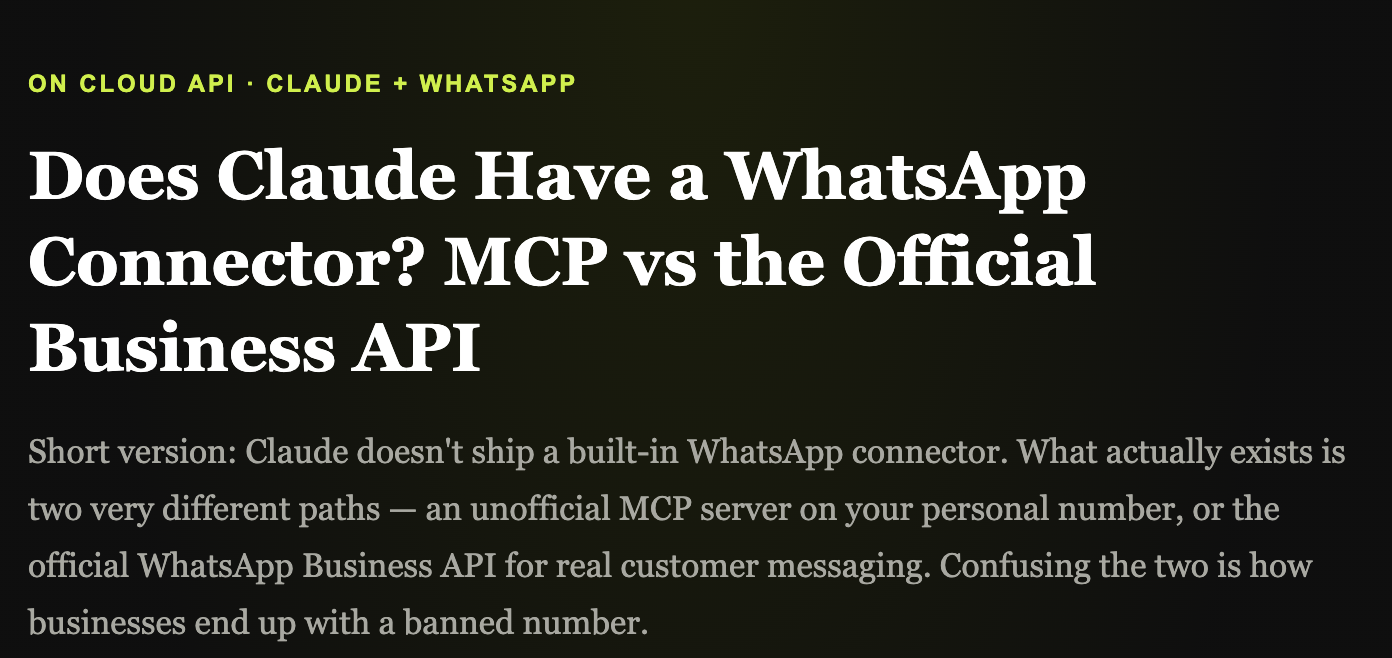
Does Claude Have a WhatsApp Connector? MCP vs the Official Business API
Short version: Claude doesn't ship a built-in WhatsApp connector. What actually exists is two very different paths — an unofficial MCP server on your personal number, or the official WhatsApp Business API for real customer messaging. Confusing the two is how businesses end up with a banned number.
Anthropic doesn't build a native WhatsApp connector for Claude. Community projects like lharries/whatsapp-mcp, and hosted services like Blueticks or Wassenger, connect Claude to a personal WhatsApp number through an unofficial WhatsApp Web bridge — useful for personal read-and-draft use, but it's automation WhatsApp's Terms of Service doesn't authorize, and it carries real ban risk at any volume. For a business that wants Claude actually answering customers on a verified WhatsApp number, the correct path is the official WhatsApp Business API with Claude wired in as a feature — which is exactly what On Cloud API's Ask AI does, and it carries none of that risk.
What a WhatsApp MCP server actually is
MCP — Model Context Protocol — is an open standard Anthropic introduced in late 2024 that lets an AI model call external tools through a shared interface. It isn't a WhatsApp product; it's a general connector standard, and anyone can build an MCP server for anything, WhatsApp included. That's exactly what happened: community projects such as lharries/whatsapp-mcp expose your personal WhatsApp account's messages, contacts and send function as tools Claude can call, and commercial versions of the same idea — Blueticks, Wassenger, TimelinesAI — package it as a hosted service with a login instead of a self-hosted Go bridge.
Here's the part that matters most: every one of these connects to WhatsApp the same underlying way — through the WhatsApp Web multi-device bridge (using libraries like whatsmeow or Baileys), the same mechanism that lets you use WhatsApp Web in a browser tab. That's not the official WhatsApp Business API. It's automating a regular WhatsApp session, and WhatsApp's own Terms of Service is explicit that unauthorized automated messaging can get an account banned.
The two paths, compared
- Runs on your personal number via QR-code login
- Can read your real chat history
- No Meta approval or business verification
- Violates WhatsApp's Terms of Service
- Ban risk rises sharply with volume or cold outreach
- Runs on a verified business number
- Cannot read personal/existing chat history
- Requires Meta business verification
- Fully within WhatsApp's Terms of Service
- No ban risk when used within Meta's rules
The honest trade-off: unofficial MCP is genuinely good for personal, low-volume use — reading your own chats, drafting a reply you approve before sending. It's the wrong foundation for a business that wants to message customers at any real scale, because the risk that was "low" at ten messages a day becomes serious at a thousand. On Cloud API's WhatsApp AI Agent and Ask AI features take the second path — Claude wired into the official Cloud API, so replying to customers at scale doesn't carry the ban risk of the MCP route.
Why "general-purpose Claude on WhatsApp" isn't allowed either way
Even on the official Business API, there's a second rule worth knowing: since January 2026, Meta has prohibited general-purpose AI chatbots on the WhatsApp Business Platform. An open-ended "ask Claude anything" assistant bolted onto a business number isn't permitted, regardless of which route connects it. What's allowed — and what On Cloud API's Ask AI and Flow Builder are built around — is task-based automation: answering from your own knowledge base, qualifying a lead, confirming an order, booking an appointment, and handing off to a human the moment a conversation needs judgment a script can't provide.
Country by country: what this looks like in practice
🇵🇰 Pakistan
A recurring pain point among growing Pakistani businesses is exactly the kind of thing an unofficial personal-number MCP can't fix: two sales reps replying to the same customer from different phones because nobody owns the chat. That's a shared-inbox and assignment problem, not an AI problem — Claude answering well doesn't help if two people are answering at once. The official API's multi-agent team inbox, with chats assigned to one owner, solves that structurally in a way a personal WhatsApp Web bridge never can.
Full setup detail: WhatsApp Business API in Pakistan.
🇦🇪 UAE, Dubai & Abu Dhabi
UAE businesses — in Dubai and Abu Dhabi alike — increasingly ask for the same thing: WhatsApp wired into their CRM so a customer conversation and a sales record are the same object, not two things someone reconciles manually. That's exactly the shape of task an official-API AI feature handles well: pull CRM context into the reply, log the conversation outcome, and stay inside the PDPL's consent and TDRA's compliance requirements — none of which an unofficial personal-number MCP was ever built to track.
Full setup detail: WhatsApp Business API in the UAE.
🇮🇳 India
A question that comes up often from Indian sales teams: which agent is actually converting WhatsApp conversations into closed deals, not just who replies fastest. That needs conversation data connected to CRM outcomes — again, structurally something the official API's analytics and CRM integrations are built for, and something a personal MCP session, which was never designed to report on team performance, simply doesn't do. Any AI feature answering Indian customers on WhatsApp also needs to treat phone numbers as personal data under the DPDP Act, with consent traceable back to the customer.
Full setup detail: WhatsApp Business API in India.
🇬🇧 United Kingdom
A UK business integrating WhatsApp into its wider communication system needs to think about UK GDPR from the start — where customer message data is processed and stored matters, and an unofficial MCP server routing your business's customer conversations through a personal WhatsApp Web session and a third-party's infrastructure is a much harder thing to make a clean data-processing case for than an official Cloud API deployment with a defined data flow.
Full setup detail: WhatsApp Business API in the UK.
🇺🇸 United States
US businesses running WhatsApp alongside Instagram and other channels often want the same thing: a way to tell real buyers from browsers across all of it, not just WhatsApp in isolation. That's an omnichannel inbox and analytics problem, which is where the official API's platform features apply — and where an unofficial single-number MCP session, scoped to one personal WhatsApp account, structurally can't reach.
Full setup detail: WhatsApp Business API in the USA.
🇧🇩 Bangladesh
For Bangladeshi businesses asking which WhatsApp API provider is actually reliable for AI-powered customer messaging, the answer starts with the same distinction as everywhere else: is the AI feature running on the official Cloud API, with BDT billing and local support, or on an unofficial personal-number bridge with none of that accountability behind it.
Full setup detail: WhatsApp Business API in Bangladesh.
🇦🇺 Australia
The same cross-border disclosure question that applies to any WhatsApp Business API deployment in Australia applies just as much to an AI feature layered on top: sending customer data to an AI model counts as a further disclosure, and Australian Privacy Principle 8 requires either the customer's consent or accountability for how that data is handled downstream — a requirement that's far easier to satisfy on a defined official-API integration than on an unofficial personal-number bridge with no formal data flow at all.
On Cloud API doesn't currently have a dedicated Australia country page — start from pricing or talk to the team directly for Australia onboarding.
Claude, wired into your actual WhatsApp Business number
Ask AI answers customers with Claude, on the official Cloud API, with your own system prompt and full conversation context. No unofficial bridge, no ban risk.
Frequently asked questions
Does Claude have a built-in WhatsApp connector?
No. Anthropic doesn't ship a native WhatsApp connector for Claude. What exists are third-party MCP servers built by the community and by vendors, plus WhatsApp Business API providers that wire Claude into the official platform as a business feature.
What is a WhatsApp MCP server?
MCP (Model Context Protocol) is an open standard Anthropic introduced in late 2024 that lets an AI model call external tools through a shared interface. A WhatsApp MCP server exposes WhatsApp actions — read messages, send messages, manage contacts — as tools Claude can call.
Can Claude read my WhatsApp messages?
Only through an unofficial MCP server connected to your personal WhatsApp account via the WhatsApp Web multi-device bridge. The official WhatsApp Business API cannot read a personal account's existing chat history — it only handles messaging for a registered business number.
Will connecting Claude to WhatsApp through an MCP server get my number banned?
It can. Community MCP servers connect through the WhatsApp Web bridge, which counts as unofficial automation under WhatsApp's Terms of Service. Risk is low for light, human-paced use like reading chats and drafting replies you approve, and rises sharply with bulk or cold-outreach sending. The official WhatsApp Business API carries no such ban risk when used within Meta's rules.
Can I connect Claude to my WhatsApp Business number for customer messaging?
Yes, through a Meta-verified WhatsApp Business API provider that offers Claude-powered auto-replies, such as On Cloud API's Ask AI feature — this runs on the official Cloud API rather than an unofficial MCP bridge, so it carries no ban risk and is built for real customer volume.
Can Claude run as a general-purpose chatbot on WhatsApp Business API?
No. Since January 2026, Meta has prohibited general-purpose AI chatbots on the WhatsApp Business Platform. Only task-based automation — lead qualification, order status, appointment booking, answering from a defined knowledge base — is permitted.
What's the difference between the WhatsApp MCP and the WhatsApp Business API?
The MCP route connects Claude to a personal WhatsApp account through an unofficial WhatsApp Web bridge, with no Meta approval step. The WhatsApp Business API is Meta's official platform for business messaging, requiring business verification and template approval, and it's what an actual business should build customer-facing automation on.