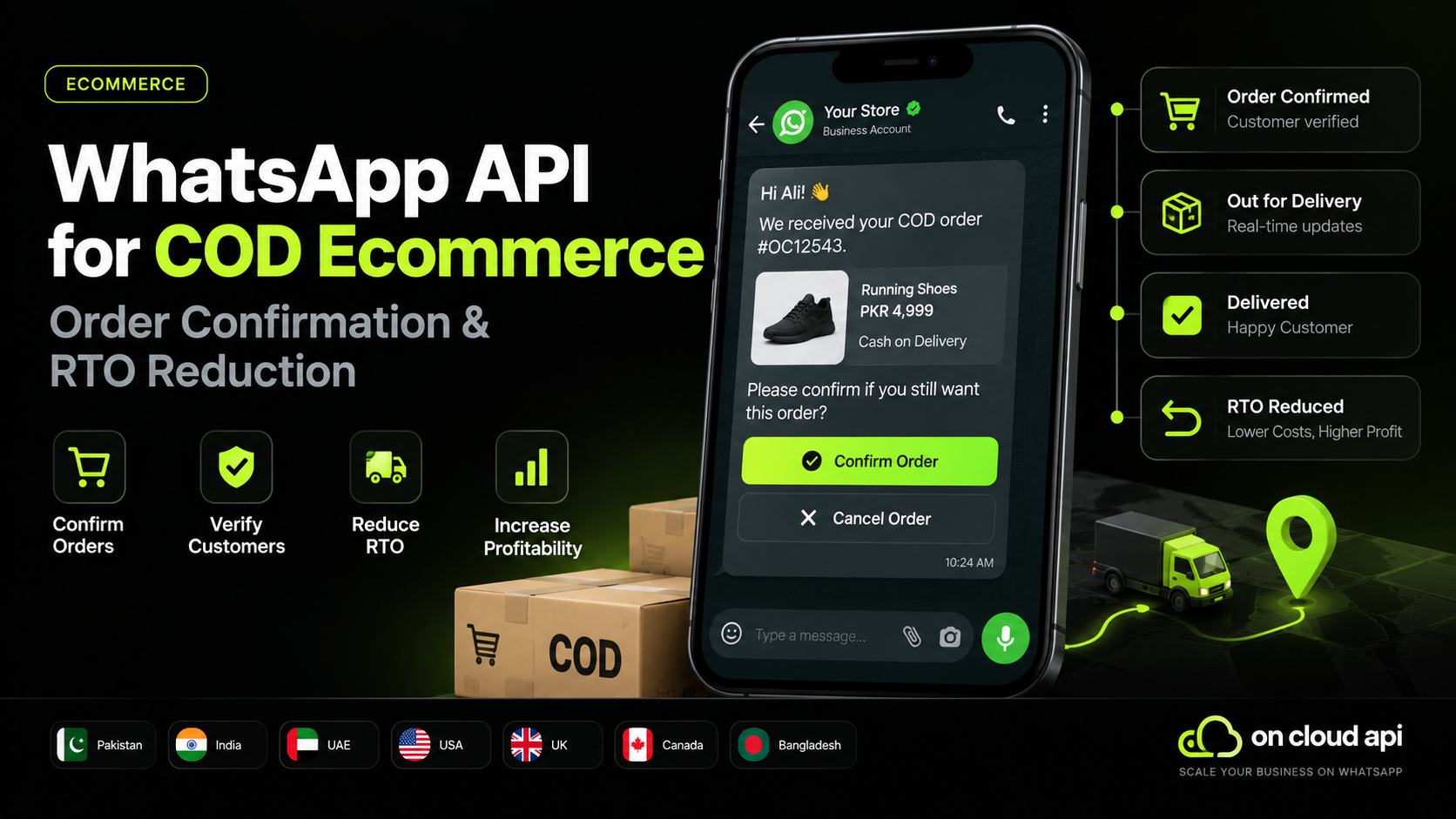
WhatsApp API for COD Ecommerce: Order Confirmation & RTO Reduction
If you run a COD-heavy ecommerce business, you already know the problem: getting an order is easy; getting that order delivered is where the real cost starts. Fake orders, wrong addresses, unreachable customers, changed minds and failed delivery attempts can turn a profitable order into an RTO loss.
WhatsApp Business API can put a confirmation and communication layer between checkout and delivery — helping you confirm COD orders before dispatch, collect corrected delivery details, send shipment updates, remind customers before delivery and recover failed deliveries.
For COD ecommerce, the most useful WhatsApp workflow is not simply "send an order confirmation." The better approach is a complete order lifecycle: order created → COD confirmation → address verification → fulfillment → shipment tracking → out-for-delivery reminder → NDR recovery → delivered or RTO. The goal is to catch avoidable problems before the merchant spends additional fulfillment and delivery costs.
WhatsApp template categories, approval rules and Meta billing policies can change. Keep transactional messages genuinely transactional, use the appropriate approved template category, and verify current Meta rules before deploying a high-volume workflow.
What you'll find in this guide
- Why COD creates an RTO problem
- How WhatsApp API works for COD confirmation
- The complete COD-to-delivery WhatsApp workflow
- COD verification and fake-order prevention
- Address verification before dispatch
- Shipment and out-for-delivery notifications
- NDR recovery and RTO prevention
- Shopify, WooCommerce and API automation
- WhatsApp templates for COD ecommerce
- Country-wise business document preparation
- Pakistan, India, UAE, USA, UK, Canada & Bangladesh
- Business verification, WABA and Blue Tick context
- How to measure RTO reduction
- Frequently asked questions
Why COD Ecommerce Has an RTO Problem
Cash on Delivery removes an important barrier at checkout: the customer does not have to pay before the product ships. That can be useful in markets where customers prefer to pay after receiving the parcel.
But the same convenience creates operational risk. A customer can place an order, change their mind, enter an incomplete address, stop answering calls or refuse the parcel when the courier arrives.
The merchant may already have paid for packaging, warehouse handling and forward shipping. If the parcel comes back, those costs can turn the original sale into a loss.
That is why a good COD operation tries to answer one question as early as possible: Does this customer still want this order?
What Is WhatsApp API for COD Ecommerce?
WhatsApp API for COD ecommerce means connecting the official WhatsApp Business Platform with your ecommerce store, order management system, CRM or courier workflow. When something happens to an order, your backend can trigger an appropriate WhatsApp communication.
Instead of an employee manually opening WhatsApp for every order, the system can automatically send the correct message and record the customer's response.
This is important because WhatsApp becomes part of the order-management workflow, rather than simply another marketing channel.
The COD Order Confirmation Workflow
The first and most obvious use case is confirming a COD order before it leaves the warehouse.
The workflow can start immediately after the ecommerce platform creates the order. The customer receives the order number, product information, amount payable and a clear action.
Hi {{1}}, thanks for shopping with {{2}}.
Your COD order #{{3}} has been received.
Order: {{4}}
Amount to pay: {{5}}
Delivery address: {{6}}
Please confirm your order so we can prepare it for dispatch.
[ Confirm Order ] [ Cancel Order ]
The exact template wording and category should be submitted and used according to Meta's current template rules. A transactional message should remain focused on the transaction instead of quietly turning into an advertisement.
Why COD Confirmation Matters Before Dispatch
Imagine a store receives 1,000 COD orders in one day. If the store ships every order without checking customer intent, the warehouse and courier may spend money on orders that were never going to be accepted.
A confirmation layer creates an opportunity to separate orders into operational groups.
| Customer Response | Recommended Workflow | Reason |
|---|---|---|
| Confirm | Release for fulfillment | Customer has explicitly confirmed intent. |
| Cancel | Cancel before dispatch | Avoid unnecessary shipping cost. |
| No response | Reminder / manual review | Intent is uncertain. |
| Address correction | Update order before dispatch | Prevent avoidable delivery failure. |
| Need help | Assign to support agent | Resolve customer concern before shipment. |
The key operational principle
Don't spend delivery money to discover that the customer did not want the order. Use WhatsApp to create a confirmation point before fulfillment.
COD Verification: WhatsApp vs Phone Calls
Many ecommerce teams still verify COD orders manually by calling customers. That can work at low volume, but the model becomes difficult when the number of orders increases.
| Factor | Manual Phone Calls | WhatsApp API |
|---|---|---|
| 1,000+ daily orders | Requires a large calling team | Automated first-level confirmation |
| Customer response | Agent records it manually | Can be captured digitally |
| Order details | Agent reads them verbally | Customer receives order information in chat |
| Address correction | Agent writes it down | Can be collected through structured workflow |
| Audit trail | Depends on CRM/call notes | Conversation and event can be linked to order |
| After-hours orders | Usually require staffing | Automation can start immediately |
This does not mean phone calls disappear. High-value or suspicious orders can still be routed to a human team. WhatsApp simply handles the predictable first layer.
Address Verification Can Prevent RTO Before It Starts
Not every RTO is caused by a fake customer. Sometimes the customer genuinely wants the product but the address is incomplete, incorrect or difficult for the courier to locate.
This is where a confirmation workflow can ask the customer to verify the delivery information before the order is dispatched.
Hi {{1}}, your order #{{2}} is almost ready to ship.
Delivery address:
{{3}}
Is this address correct?
[ Yes, Confirm ] [ Update Address ]
If the customer selects "Update Address", the system can open a form, Flow, support conversation or CRM workflow depending on the implementation.
The Full WhatsApp COD Order Lifecycle
The strongest implementation treats WhatsApp as a lifecycle rather than one isolated confirmation message.
If something goes wrong at the delivery stage, another branch begins:
Order Shipped: Keep the Customer Informed
Once the order leaves the warehouse, the customer should not have to wonder whether the parcel has actually been shipped.
A WhatsApp utility message can communicate the shipment status and provide a tracking link where applicable.
Hi {{1}}, your order #{{2}} has been shipped.
Courier: {{3}}
Tracking ID: {{4}}
Expected delivery: {{5}}
[ Track Order ]
The objective is simple: reduce uncertainty and give the customer one place to find their order information.
Out-for-Delivery WhatsApp Reminder
The out-for-delivery stage is particularly important for COD because the customer needs to be available and ready to receive the parcel.
🚚 Hi {{1}}, your order #{{2}} is out for delivery today.
Amount payable: {{3}}
Please keep your phone active and make sure someone is available at the delivery address to receive the parcel.
[ Track Delivery ] [ Need Help ]
This type of communication can address simple operational problems before they become a failed delivery.
NDR: Where WhatsApp Can Become an RTO Recovery Tool
NDR — Non-Delivery Report — means the courier attempted delivery but could not complete it. The reason might be customer unavailable, incorrect address, phone unreachable, delivery reschedule or another courier exception.
Without follow-up, an NDR can eventually become an RTO.
That is why an NDR webhook from the courier or logistics system can trigger a WhatsApp recovery workflow.
Hi {{1}}, we couldn't deliver your order #{{2}} today.
We can arrange another delivery attempt.
[ Reschedule Delivery ]
[ Update Address ]
[ Contact Support ]
The customer's response can then be sent back to the ecommerce or logistics system. A support agent can take over when the automated flow cannot resolve the problem.
The RTO Reduction Loop
A useful mental model is to treat every failed delivery as a recovery opportunity before the shipment becomes RTO.
WhatsApp does not magically "reduce RTO by X%." It creates additional opportunities to prevent or recover specific causes of failed delivery. Your actual improvement depends on product category, customer quality, courier performance, geography, address quality and your existing RTO baseline.
Shopify + WhatsApp API for COD Ecommerce
Shopify stores can connect order events with WhatsApp automation through apps, webhooks, APIs or workflow platforms.
A basic workflow can look like:
The customer response can travel back into the same workflow:
For example, "Confirm Order" can add a confirmed tag or move the order into the fulfillment queue, while "Cancel Order" can trigger an internal cancellation process.
WooCommerce + WhatsApp API for COD
WooCommerce stores can follow a similar model using WordPress plugins, REST APIs, webhooks or custom backend integrations.
The architecture can connect:
- WooCommerce order creation
- COD payment method
- Customer phone number
- WhatsApp template
- Customer response
- Order status
- Courier tracking
- NDR events
For larger stores, a direct API or automation layer gives more control than manually sending notifications from the WhatsApp Business App.
WhatsApp Templates Every COD Store Should Think About
| Template | Purpose | Typical Stage |
|---|---|---|
| Order Confirmation | Confirm that the order was received. | Immediately after order creation |
| COD Confirmation | Capture customer intent before dispatch. | Before fulfillment |
| Address Check | Verify or correct delivery details. | Before shipping |
| Order Packed | Tell customer the order is being prepared. | Warehouse stage |
| Shipment Update | Provide courier and tracking details. | After dispatch |
| Out for Delivery | Prepare customer for delivery. | Last-mile stage |
| Delivery Failed | Start NDR recovery. | After failed attempt |
| Delivered | Confirm successful delivery. | After delivery |
The key is to make each message correspond to a real order event. Current ecommerce template examples across the market similarly structure order confirmation, shipping, delivery and failed-delivery communication around the customer's existing transaction.
What Should a COD WhatsApp Message Contain?
- Customer name
- Order number
- Product or order summary
- Total amount or COD amount
- Relevant delivery information
- One clear next action
- Tracking or order link when appropriate
- Support option where necessary
Avoid filling a transactional message with unrelated promotions. If you want to promote another product or discount, use the appropriate marketing workflow and template rather than mixing promotional content into a transaction notification.
COD Verification With OTP: When Does It Make Sense?
Some ecommerce businesses use an OTP-based verification step for COD orders. That can be useful where phone ownership or a stronger verification signal is important.
But OTP should not automatically be added to every order simply because it is technically possible.
| Approach | Best Use | Trade-off |
|---|---|---|
| Simple confirmation | Normal COD orders | Lowest friction |
| Confirm / Cancel buttons | High-volume COD operations | Requires good workflow integration |
| OTP verification | Higher-risk or higher-value flows | More customer friction |
| Human callback | Exceptions / suspicious orders | Higher operational cost |
The best setup is usually a risk-based system rather than forcing every customer through the most complicated verification method.
How to Build a COD Risk Score
Once WhatsApp is connected to your order system, the business can combine customer signals with order events.
| Signal | Possible Meaning | Action |
|---|---|---|
| Immediate confirmation | Positive purchase intent | Normal fulfillment |
| No response | Uncertain intent | Reminder / review |
| Customer cancels | Order no longer wanted | Cancel before shipping |
| Address correction | Potential delivery issue | Fix before dispatch |
| Previous RTO history | Potential higher operational risk | Additional verification |
| Multiple recent COD orders | Potential unusual activity | Manual review |
Do not treat a risk score as proof of fraud. It is simply a way to prioritize which orders deserve more attention.
Pakistan: Why COD + WhatsApp Is a Strong Ecommerce Use Case
Pakistan is one of the markets where COD remains especially important for ecommerce operations, making confirmation and delivery communication highly relevant.
For a Pakistani ecommerce store, the workflow can be particularly practical:
- Customer places COD order.
- WhatsApp sends confirmation in English, Urdu or Roman Urdu.
- Customer confirms or cancels.
- Address is checked before dispatch.
- Courier tracking is sent through WhatsApp.
- Out-for-delivery reminder is sent.
- NDR event triggers a recovery message.
On Cloud API's Pakistan resources cover WhatsApp Business API setup, ecommerce use cases and local business onboarding.
Read the detailed WhatsApp Business API in Pakistan guide if Pakistan is your primary market.
Country-Wise Business Document Preparation for WhatsApp API
This is one area where ecommerce businesses expanding internationally often make a mistake: they assume that every country uses the same business documents.
They do not.
A Pakistani company, Indian business, US LLC, UK limited company, UAE company, Canadian corporation and Bangladeshi business can have completely different legal and tax identifiers.
Important: This is a preparation map — not a universal Meta checklist
The documents below are practical business-identity records that businesses may need to keep ready depending on their legal structure and onboarding or verification scenario. Meta's actual requirements can vary by business, country, entity type and verification flow.
| Country | Common Business Record | Tax / Registration Identifier | Preparation Focus |
|---|---|---|---|
| 🇵🇰 Pakistan | SECP incorporation / registration documents where applicable | NTN / FBR records | Legal name, website, address, business identity and dedicated business number |
| 🇮🇳 India | Company / LLP / proprietorship records | PAN, GSTIN where applicable, Udyam where applicable | Keep legal entity information consistent across business assets |
| 🇺🇸 USA | State incorporation / LLC formation documents | EIN where applicable | Legal entity name, formation record and tax identity |
| 🇬🇧 UK | Companies House incorporation records | Company Number / CRN | Match public company information with business identity |
| 🇦🇪 UAE | Trade Licence / company formation records | Applicable licence and tax records | Legal name, trade name, licence information and website consistency |
| 🇨🇦 Canada | Federal / provincial incorporation records | Business Number (BN), GST/HST where applicable | Business identity, incorporation and CRA information |
| 🇧🇩 Bangladesh | Company registration / business registration | TIN, VAT/BIN where applicable | Trade licence, tax identity and company records |
This country-specific mapping is particularly useful for ecommerce companies that operate multiple stores or legal entities across different markets.
Pakistan: SECP + NTN
A Pakistani company may have SECP incorporation or registration records and an NTN associated with its tax identity. Depending on the legal structure, the exact documentation differs.
For WhatsApp Business onboarding, the practical goal is consistency between your business identity, website, Meta Business information, WhatsApp profile and supporting records.
For a deeper look at Pakistan onboarding and Blue Tick context, see: WhatsApp Business API in Pakistan — 0% Markup & Blue Tick .
India: PAN, GST, Udyam & Entity Records
India has several business structures, which means the relevant documents can differ. A company, LLP, partnership and individual business do not necessarily have identical records.
For ecommerce onboarding, prepare the documents that actually correspond to your entity rather than copying another business's checklist.
USA: EIN & Formation Records
For a US ecommerce company, the EIN is a key federal business tax identifier where applicable. Formation documents can also provide evidence of the legal entity.
The important point is that an EIN itself is not the same thing as Meta Business verification. They are separate systems.
UK: Companies House & Company Number
UK limited companies have public company information through Companies House, including their company number and incorporation information.
Keeping those records aligned with the business name, website and Meta Business information makes the onboarding process easier to manage.
UAE: Trade Licence
UAE businesses commonly operate under a trade licence or relevant business licence, depending on their jurisdiction and structure.
For a UAE ecommerce company, keep the applicable licence, company information, business address and website details organized.
Canada: Business Number
Canadian businesses may have a CRA Business Number (BN) and, depending on their activities, GST/HST accounts and incorporation records.
The relevant documentation depends on the entity and registration route.
Bangladesh: TIN, Trade Licence & VAT/BIN
Bangladeshi businesses can have different business registration and tax records depending on their structure and activities.
Common preparation can include trade licence, TIN and VAT/BIN records where applicable, along with company registration documentation for incorporated businesses.
Business Verification Is Not the Same as a Blue Tick
COD ecommerce businesses often mix together several different WhatsApp and Meta entities.
| Entity | What It Means |
|---|---|
| Meta Business Manager | Business environment used to manage Meta business assets and identity. |
| Business Verification | Meta process for verifying business identity and information. |
| WABA | WhatsApp Business Account associated with WhatsApp Business Platform assets. |
| Official Business Account | A separate eligibility-based official account / identity concept. |
| Meta Verified for Business | A Meta verification product with its own availability and eligibility. |
| Quality Rating | An important messaging-health signal affected by customer feedback and messaging behaviour. |
| BSP / Solution Partner | A Meta partner route through which businesses can access WhatsApp Business Platform services. |
| Tech Provider | A partner model that can provide direct Cloud API connectivity and platform tooling. |
If your goal is specifically the WhatsApp Blue Tick, read: How to Get the WhatsApp Blue Tick in 2026 .
A Blue Tick Does Not Automatically Reduce RTO
A verified business identity can help customers recognise a brand, but it does not solve the underlying operational causes of RTO.
RTO reduction comes from better order operations:
- Confirming customer intent
- Checking address quality
- Providing tracking information
- Preparing customers for delivery
- Recovering failed delivery attempts
- Giving customers a simple support path
Verification builds trust. Automation improves operations. NDR recovery protects delivery economics.
WhatsApp Compliance for COD Ecommerce
COD automation should not become an excuse to send every possible message to every customer.
The business should maintain appropriate customer consent and use the correct WhatsApp template category for the purpose of the message.
A genuine order confirmation is different from a promotional campaign. A shipping update is different from a product recommendation. An OTP is different from a marketing broadcast.
If you are scaling WhatsApp messaging, read: How to Get a WhatsApp Business Account That Doesn't Get Banned .
You can also read: Why WhatsApp Gets Banned — and How to Unban It for a deeper look at opt-in, quality rating, templates and compliance.
What Happens If Your COD Customer Doesn't Reply?
No response should not automatically mean "fake order." It should mean "uncertain order."
A sensible workflow can use a reminder and then route the order to a manual review queue if the customer remains unresponsive.
This is safer than automatically cancelling every customer who misses the first message.
How to Connect WhatsApp API With Your Courier
The most powerful RTO workflows start when WhatsApp receives real delivery events from the logistics system.
For example:
- Shipment created
- Picked up
- In transit
- Out for delivery
- Delivery failed
- Customer unavailable
- Address issue
- Delivered
- Returned to origin
Each event can become a trigger in your automation layer.
n8n + WhatsApp API for Advanced COD Automation
If your ecommerce operation needs more complex logic, an automation platform such as n8n can sit between your ecommerce store, courier, CRM and WhatsApp layer.
For example:
You can use the same architecture to automate COD confirmation, customer support, delivery updates, abandoned cart workflows and NDR recovery.
For more examples, see: WhatsApp Business API + n8n, Zapier, Zoho & AI Agents .
How to Measure Whether WhatsApp Is Actually Reducing RTO
Do not judge the success of a WhatsApp COD workflow by message delivery alone. The business outcome is what matters.
| KPI | What It Tells You |
|---|---|
| COD Confirmation Rate | How many COD orders customers actively confirm. |
| Pre-Dispatch Cancellation Rate | How many unwanted orders are stopped before shipping. |
| Dispatch Rate | Percentage of orders released to fulfillment. |
| Delivery Success Rate | Percentage of shipped orders successfully delivered. |
| NDR Recovery Rate | Percentage of failed deliveries recovered after follow-up. |
| RTO Rate | Returned shipments divided by shipped orders. |
| Cost Per Delivered Order | Total operational cost divided by successful deliveries. |
| COD Contribution Margin | Actual profit after logistics, RTO and communication costs. |
The Right Way to Test RTO Reduction
Before claiming that WhatsApp reduced RTO, establish a baseline.
For example, compare a defined period before automation against a comparable period after automation while controlling for product mix, geography and courier changes.
Track not only the overall RTO percentage but also the reason codes behind failed deliveries.
- Same product category
- Comparable order volume
- Similar geography
- Same or comparable courier mix
- Track confirmation rate
- Track NDR recovery
- Change courier at the same time
- Change COD policy simultaneously
- Change product pricing
- Change ad targeting
- Measure only message delivery
- Claim a fixed RTO reduction without baseline
On Cloud API for COD Ecommerce
On Cloud API provides a WhatsApp Cloud API platform for businesses that need WhatsApp messaging, shared team inboxes, automation, chatbots, AI agents and ecommerce workflows.
Its platform currently advertises 0% stated markup on Meta messaging rates, with platform pricing handled separately. That matters for high-volume ecommerce because the total communication cost depends on both the Meta messaging charges and the software layer you use.
You can explore the On Cloud API WhatsApp Business API platform or check the current pricing and plans .
Who Should Use WhatsApp API for COD?
High-Volume D2C Brands
If your store receives hundreds or thousands of COD orders, manual confirmation quickly becomes expensive. Automation can handle the first-level confirmation while your team handles exceptions.
Fashion & Apparel Stores
Fashion stores often deal with high order volume and customer support questions. WhatsApp can combine order confirmation, delivery updates and customer assistance in one conversation.
Beauty & Cosmetics Ecommerce
Beauty brands can use transactional WhatsApp messaging to keep customers informed through fulfillment and delivery while keeping promotional messaging separate.
Electronics Stores
Higher-value COD orders can benefit from additional confirmation and exception handling before the merchant commits to fulfillment and shipping costs.
Marketplace & Multi-Store Operators
Businesses operating multiple stores can centralize WhatsApp workflows while connecting different order systems to the same communication infrastructure.
Seven-Country Opportunity: One WhatsApp Ecommerce Strategy
| Market | COD / Ecommerce Opportunity | Business Identity Preparation |
|---|---|---|
| 🇵🇰 Pakistan | COD confirmation, NDR recovery, delivery updates | SECP / NTN / applicable business records |
| 🇮🇳 India | COD verification, D2C order updates, support | PAN / GSTIN / Udyam / entity records where applicable |
| 🇦🇪 UAE | Delivery coordination, ecommerce support and order notifications | Trade licence / company records |
| 🇺🇸 USA | Order updates, shipping notifications and support | EIN / state or federal formation records where applicable |
| 🇬🇧 UK | Order notifications and delivery communication | Companies House / Company Number |
| 🇨🇦 Canada | Order tracking, customer service and delivery workflows | Business Number / incorporation records |
| 🇧🇩 Bangladesh | COD confirmation, delivery updates and support | TIN / Trade Licence / VAT-BIN where applicable |
The important SEO and business opportunity here is that most generic ecommerce articles stop at "order confirmation" and "delivery notification." A stronger resource connects the entire COD lifecycle with business onboarding context for multiple countries.
Ready to Automate Your COD Ecommerce Orders on WhatsApp?
Connect your ecommerce workflow with WhatsApp Business API and build automated confirmation, customer support, delivery and NDR workflows with On Cloud API.
Frequently Asked Questions
Can WhatsApp API reduce COD RTO?
Yes. WhatsApp can help reduce avoidable RTO by confirming customer intent before dispatch, checking delivery information, sending out-for-delivery reminders and creating NDR recovery workflows. The actual improvement depends on your baseline RTO, courier performance, product category and customer behaviour.
How does WhatsApp COD order confirmation work?
When a COD order is created, your ecommerce system can trigger a WhatsApp message containing the order details and a confirmation action. The customer's response can then be connected back to the store or order-management workflow.
Can I confirm COD orders with WhatsApp buttons?
Yes. Interactive actions such as confirmation or cancellation can be used where supported by the applicable WhatsApp template and messaging workflow.
Can WhatsApp API verify COD customers with OTP?
Authentication workflows can be used for suitable verification scenarios. However, not every COD order needs OTP. Use the least-friction verification method that solves the actual business problem.
Can WhatsApp API connect with Shopify?
Yes. Shopify stores can connect WhatsApp workflows through apps, webhooks, automation platforms or direct API integrations depending on the architecture.
Can WhatsApp API connect with WooCommerce?
Yes. WooCommerce can connect to WhatsApp through plugins, webhooks, REST APIs or a custom backend integration.
What is NDR in ecommerce?
NDR stands for Non-Delivery Report or a failed delivery event. It indicates that the courier could not complete delivery. An automated WhatsApp recovery workflow can give the customer a chance to reschedule or correct delivery information before the parcel becomes RTO.
Does WhatsApp automatically guarantee lower RTO?
No. WhatsApp is a communication and automation layer. It can create more opportunities to prevent failed deliveries, but your actual RTO result depends on customer behaviour, courier quality, address accuracy, product category and operational execution.
What documents should a Pakistani ecommerce business prepare for WhatsApp API?
Depending on the legal structure, useful preparation can include SECP or business registration records, NTN/FBR information, a matching business website and other business information requested during the applicable Meta onboarding or verification process.
Is a trade licence enough for WhatsApp Business verification in the UAE?
A trade licence is an important business record, but it does not automatically guarantee Meta Business verification or any particular WhatsApp verification badge. Meta's own eligibility and verification process remains separate.
Is an EIN the same as WhatsApp Business verification in the USA?
No. An EIN is a US federal tax identifier. Meta Business verification is a separate platform process.
Does On Cloud API charge a markup on Meta messaging rates?
On Cloud API currently advertises 0% stated markup on Meta messaging rates. The platform subscription is separate from Meta's applicable messaging charges.
Bottom Line
If you are running COD ecommerce, the biggest mistake is to think about WhatsApp as just an order-notification channel.
The real opportunity is to connect WhatsApp to the entire order lifecycle: confirmation, address verification, fulfillment, shipment tracking, out-for-delivery communication and NDR recovery.
The earlier you identify an unwanted order or a delivery problem, the less money you have already spent on fulfillment and logistics.
For businesses operating across Pakistan, India, UAE, USA, UK, Canada and Bangladesh, there is another layer: business onboarding is not identical across countries. Prepare the legal entity and tax records that actually apply to your business, and keep your business identity consistent across your website, Meta assets and WhatsApp profile.
The end goal is simple: ship more of the orders customers actually want, recover more of the deliveries that initially fail, and stop avoidable logistics costs before they become RTO.